Oct 1, 2026
Sept 2026 Market Commentary
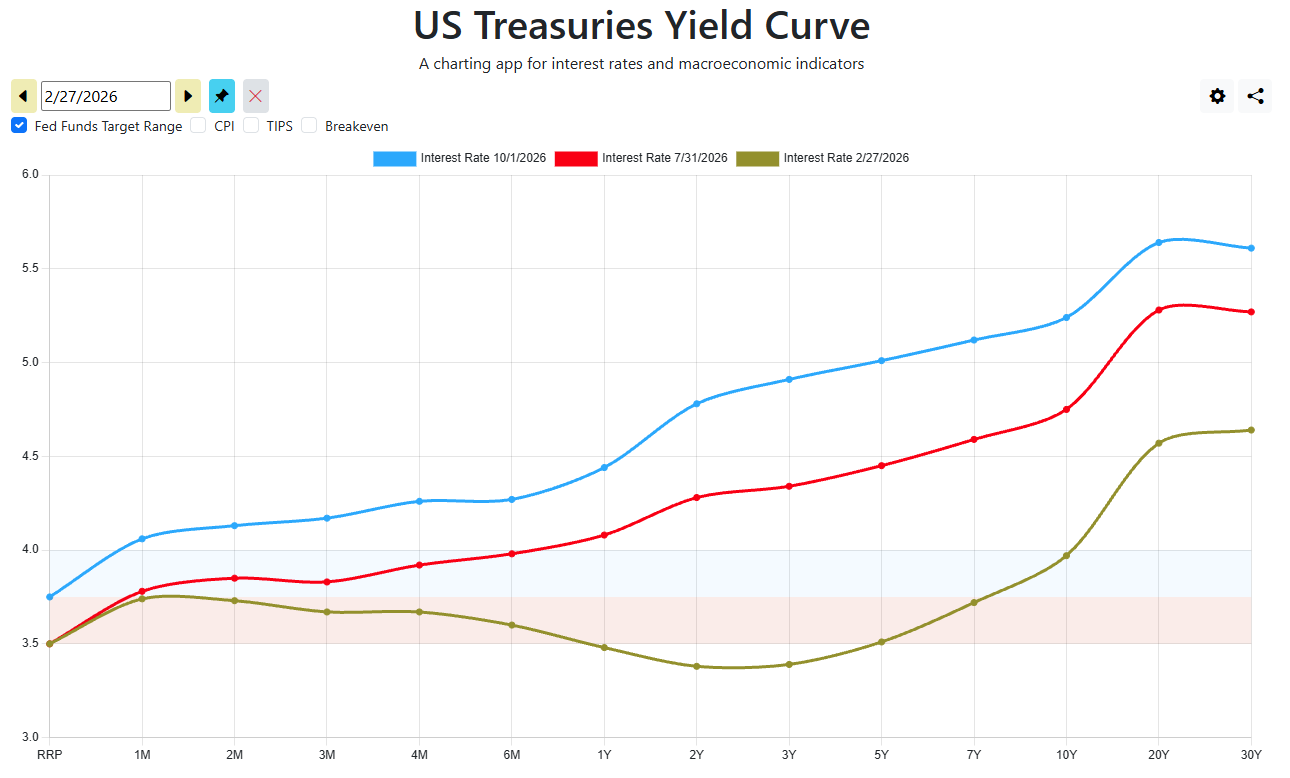
The key development in September was the dramatic increase in bond yields across the yield curve. The US 10 Year Treasury witnessed a 53-basis point increase (~1/2 of 1%) in its yield, from 4.76% on August 31 to 5.29% on September 30. This continued the trend take took hold in August. Since July 31 bond yields with maturities under 1 Year have increased by about 1/4 to 1/3 of a point, while maturities longer than 1 Year have increased by about 1/2 of a point.Such significant moves, especially in such a short period of time, are very rare. Yields above 5% for the US 10 Year Treasury indicate that the era of “free money” that existed for much of the past decade are gone. The environment is more reminiscent of the early 2000’s, when the 10 Year’s yield was generally in the range of 5-6%. We may even see a return to yields observed in the 90’s, when the 10 Year had yields close to 8% early in the 90’s, decreasing towards 6% by the start of the millennium.
Stocks have mostly gone sideways and declined slightly in this environment, while fixed income (i.e. bonds) have seen larger declines. Bonds with maturities under 1 Year, and especially under 4-6 months, have maintained an even or positive total return (with bond interest offsetting minor capital losses). Essentially, short-term fixed income has been the only asset class to have avoided declines.
The major factors that have brought about this shift are:
• The Iran War. Major increases in oil prices, and the resulting inflation that is working its way through the economy, have set bonds into a tailspin. Since March 1 short-term maturities have increased by about 3/4 of a point, while maturities from 1 – 10 Years have increased by 150 basis points (1.5%). See the image below.
• A growing US Budget Deficit, with total US Debt now over $40 Trillion dollars. Made worse by the tax cuts of the “One Big Beautiful Bill” of 2025.
• The Federal Reserve being forced to respond with higher short-term rates, and lack of confidence in our new Fed Chair Kevin Warsh. Not only is worsening inflation forcing his hand, but also the need to establish independence from the political influence of the President.
• Worsening US Relations with the rest of the world, who are decreasing their holdings of US Debt. Europe, China, and other nations now are trimming their holdings of US Treasuries as their bonds mature, and are even reducing holdings through outright sales of US Debt. The resulting increases of US Debt in the open marketplace suppresses bond prices, resulting in increasing bond yields (bond yields move inversely to price).
Beyond the financial markets, the impact on the broader economy is also damaging. Mortgage rates have shot up to 7.25% in recent months, consumer debt, auto loans, and other forms or credit, are all becoming more costly. All while prices for everyday goods also increase. In short, consumer credit and goods and services are both becoming more costly, by substantial amounts in 2026.
Aug 31, 2026
Aug 2026 Market Commentary
Stocks advanced in the first half of August, then declined slightly for the remainder of the month. For the month as a whole, the S&P 500 gained 196 points, ending the month at 7686, but declined from a peak value of 7797 on August 13. Traders seemed to hesitate in making big bets with the Fed potentially raising rates in September, an unresolved war with Iran that drags on, the historically poor months of September and October on the horizon, and the mid-term elections coming in November. Pundits have varied opinions, with some arguing that the market is vastly over-valued, while others believe the major indices will continue to advance at least until the early 2030’s.
Fixed income (i.e. bonds) also moved sideways, with the 10-Year US Treasury moving within a 15-basis point (bps) range (15 hundredths of one percent), and ending the month just 3 bps above where it started, ending at 4.775%. Short (under 1 year) to mid-term bonds (3- 7 years) did increase yields somewhat (3 – 8 basis points) as the market does now anticipate a quarter point increase in rates by the Fed in September.
Aug 2, 2026
July 2026 Market Commentary
Stocks trended sideways for the month, as confidence in sustained advances from AI wavered. The S&P 500 ended the month at 7489, ten (10) points below where it began the month at 7499. The reality of a more protracted conflict in the Middle East may also be sinking in.
Meanwhile, fixed income (i.e. bond) investors grew more skeptical during the month concerning the prospects for inflation. Federal Reserve Chair Kevin Warsh also earned a vote of no confidence at the Fed’s Meeting last week. The Fed held rates steady, but three (3) members (in a 9 to 3 vote) dissented, voting to raise rates.
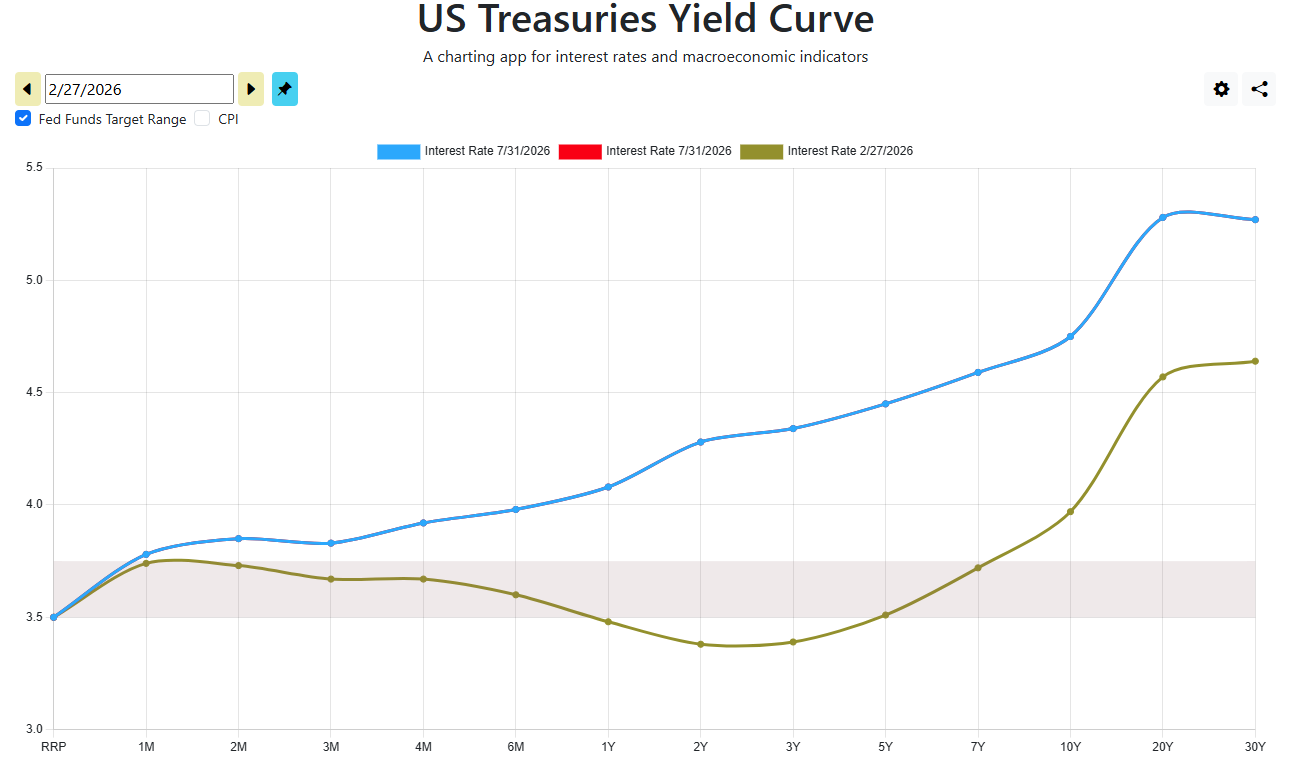
For 2026 as a whole, the yield curve (bond yields, measured by maturities, from overnight to 30-year rates) has trended up. For much of the curve by 25 – 80+ basis points (hundreds of 1%). While the Fed holds rates steady (at last week’s meeting) from 3.5% – 3.75%, the market has already sold off short-term bonds, pushing yields up to 3.8% for 1-month notes, to 4.08% for 1 year and 4.28% for 2-year maturities. In effect, the market has decided that the Fed is acting too slowly, and now forecasts rates in the 4% – 4.25% range within a year or two.
This stands in contrast to the outlook at the beginning of the year, when 2-year US Treasuries yielded just 3.47%. So, to be exact, the 2-year Treasury has increased its yield by 81 bps (basis points) in just the past seven (7) months! Rates were actually trending downward for the first two months of the year, until the start of the Iran War. On Feb 28 the yield on the 2-Year US Treasury stood at just 3.38%. On Friday it was up 90 bps (basis points) to 4.28%.
Similar trends can be observed with the important 10-year US Treasury Bond. Here, yields now stand at 4.75%, up a substantial 31 bps (basis points) from 4.44% on June 30, and up 57 bps (basis points) from 4.18% on January 1. To the average person these seem to be arcane developments. In fact, the Yield Curve is used as the benchmark for credit card rates, auto loan rates, and mortgages. As a result, accelerating inflation and a rising yield curve are flashing warning lights for the economy ahead.
Rising yields also increase the cost that the government must pay to finance ongoing debt spending. Debt service crowds out available funds for programs such as Social Security, Medicare, and Defense. At roughly $1 Trillion in 2026, debt service now costs more than the US Defense Budget, estimated at $895 – $960 Billion. The United States enjoyed low inflation averaging 1.5% from 1990 to 2020. We may now be exiting that benign period and be facing inflation more like that from the late 1960s to the mid-1980s.
Source: ustreasuryyieldcurve.com
July 2, 2026
June 2026 Market Commentary
Stocks trended downward slightly during June, despite the improving situation in the Middle East. The S&P 500 declined from a YTD gain of 10.7% in May to a 9.5% gain by the end of June. The key issue was increasing concern and skepticism over the value of the “Magnificent Seven” stocks (Alphabet, Amazon, Apple, Meta, Microsoft, Nvidia, and Tesla) and valuations for AI stocks.
The NASDAQ Composite declined by about 5% pts. in June, while mid-cap and especially small-cap stocks showed healthy gains, indicating rotation out of tech stocks and a broadening of stock ownership beyond the largest corporations. These gains were reflected by an increase of about 3% pts. for the Russell 2000 Index, which includes not just the largest 500 stocks in the market, but 2000 top stocks which includes not just large cap but also mid-and-small-cap equities.
Meanwhile, fixed income (i.e. bonds) moved mostly sideways. Although oil prices came down during the month, inflation is believed to remain an ongoing issue for the balance of the year, albeit less acute of a risk than forecasted a month ago. The President got his new Fed Chief, who declined to cut rates at his first Fed meeting. Meanwhile, expectations remain that rates will go up by a quarter point before 2026 comes to a close. Nonetheless, the bond market took things in stride as at least two rate increases were expected a month or two ago.
With stocks having tripled in value in the past five years valuations, especially those of tech and AI stocks, remain elevated. Increasingly, the market seems to be recognizing this fact.
May 31, 2026
May 2026 Market Commentary
Equities continued to advance strongly in May, driven by healthy earnings, with little concern over the unresolved War with Iran. Excitement continues to grow with the near-term IPOs (Initial Public Offerings) of firms such as SpaceX, Anthropic, and OpenAI. The S&P 500 advanced to a YTD gain of 10.7% by May 29, up from 5.3% in April.
Meanwhile, the bond market took a more sober view. Yields spiked in mid-month, and have come down as May came to a close, but remain somewhat higher (yields move inversely to price) from where they began the month. The Aggregate US Bond Market ended the month about where it started.
Bond investors often take a more sober view than stock pundits, and some argue a more realistic view. The question also comes up increasingly about whether we are in a bubble for stocks. The tech sector now holds 52% of the market capitalization of the entire S&P 500 (compared to 8.3% for healthcare). Meanwhile, the IPOs of SpaceX, Anthropic, and OpenAI suggest this imbalance will grow even more acute.
Consider than during the “dot com” boom of 1999 & 2000 companies such as Sun Microsystems had Price-to-Sales ratios of 10. In contrast, the expected Price-to-Sales ratio for the coming SpaceX IPO is expected to be close to 93 times sales. Meaning an investor buying SpaceX stock would have to wait 93 years to earn back their investment, if SpaceX had zero expenses, zero research and development, and zero payroll. Stocks outside of technology may be fairly priced, but it is hard to ignore the possibility of a bubble for tech stocks, and the overall market equity indices.
May 1, 2026
April 2026 Market Commentary
Markets recovered dramatically, and somewhat surprisingly, in April despite the ongoing war in Iran. Deciding whether investors are extremely savvy, or complacent, is a hard choice. The fact that there has been a cease fire is clearly a factor, but does not fully explain the bullish outlook while oil remains well over $100 per barrel, inflation is accelerating to the 4% range, and global stockpiles of oil, gasoline, diesel, and jet fuel are projected to run out within the next month. Such a development could lead to a further spike in oil prices, and drive inflation throughout the global economy for the balance of 2026.
For the month the S&P 500 surged from a YTD loss of -4.6% in March to a YTD gain of +5.3% by the end of April, to have the best monthly performance since 2020. Global markets also accelerated at a torrid pace, with an increase from -3.9% to +5.2% for the MSCI ACWI (Morgan Stanley All Cap World Index).
Fixed income markets took a different and more pessimistic view, with the US Fixed Income market (as measured by AGG, the iShares US Aggregate Fixed Income Index ETF) softening from a YTD loss of -0.6% in March to -0.8% in April. International Fixed Income (as measured by IAGG, the iShares Global Aggregate Fixed Income Index ETF) moved in sympathy from +0.1% to -0.2% YTD. The key factor being an increase in bond yields as inflation threatens bondholders who now demand higher yields.
The contrasting viewpoint between fixed income and equities is interesting. Declines in fixed income are closer to what most observers would probably have foreseen a month or two ago. At least one observer noted that most Wall Street Professionals are now young enough to have no recollection of events such as inflation of the 1970s, the stock market crash of 1987, the Asian Financial Crises of the late 90s, the Dot Bomb crash of 2000, and even the 2008 Financial Crises. Having come of age over the past two decades when market selloffs usually lead to a quick rebound and a “buy the dip” mentality, perhaps the reaction of the stock market is not a surprise, though one that could be ignoring potentially negative outcomes.
For now, there seems to be little chance of a quick resolution to the War with Iran. Some pundits are now referring not to TACO (Trump Always Chickens Out) but NACHO (Not A Chance that Hormuz Opens). If oil remains well over $100 per barrel for a protracted period and possibly spikes as global stockpiles of fuel evaporate, can markets continue to surge upward? Those with a long-term investment time horizon may be able to ignore these risks and stay fully invested. Those with a shorter-term horizon may be well advised to remain vigilant.
Peter Gaylord, CFA
Gaylord Wealth Management, LLC
Rocklin, CA